Every back-office bottleneck ends up as the same meeting. Volume is up, the team is at capacity, and somebody has to decide whether to add a person, add a tool, or do something else. The three are usually compared on price, which matters least. They scale differently, and that is what decides it.
The growth moment
It does not arrive as a crisis. It arrives as a slow change in the texture of the week.
Orders are up. Invoices are up. The AP inbox has a Monday backlog it did not use to have, and the 3-way match that got done the same day now gets done the next. Somebody has started staying late — not every night, but enough that you have noticed. Nobody has missed anything important yet.
So the question lands on your desk, and it lands in the least useful form: can we get another person approved?
That is a real option, and sometimes the right one. But it is one of three, and they are not variations on a theme. Hiring buys you a block of capacity that comes in whole units and costs the same whether you use all of it or half. A seat-priced tool buys you a fixed monthly cost and a share of the work, leaving the remainder exactly where it was. An agent priced per outcome buys you a variable cost that tracks volume, after a fixed cost up front. Those three shapes behave very differently over three years.
Option one: hire another person
People come in whole numbers. If one person can handle a thousand units a month and you are doing twelve hundred, you need two people — and the second one spends a chunk of the month with spare capacity you are paying for. Push it to twenty-one hundred and you need three, and the third one starts the same way the second did.
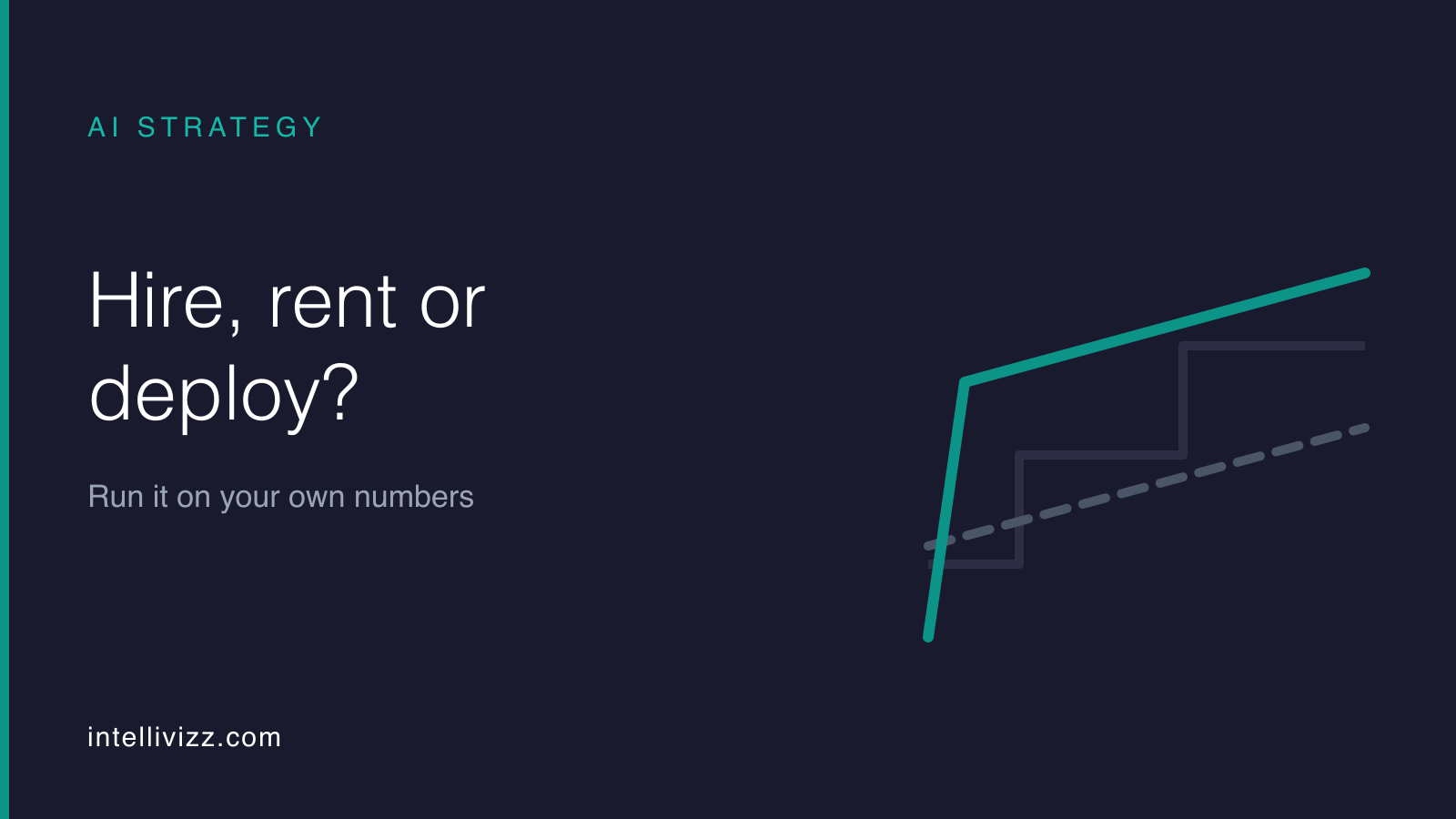
That is why the hiring line is a staircase and not a slope. Between the steps, growth is free. At each step, it is expensive all at once.
Then the costs around the salary, which people leave out of the comparison and discover anyway:
- Recruiting. Advertising, an agency if the market is tight, and the interview hours of people who are already busy — the real cost, and the one never counted.
- Ramp. A new person is slower and more error-prone than the person training them, and the trainer is slower too while they do it. That period is paid for twice.
- Turnover. Back-office roles turn over. Every time one does, you pay the recruiting and the ramp again, and you pay it on a schedule you do not control.
- The know-how walking out. The person who has done credit holds for four years knows which customers always pay late and are fine, which ones go quiet before they go bad, and which buyer will approve a short-ship over the phone. None of that is written down. When they leave, it leaves.
A person is also the only one of the three who can do something you did not anticipate. That is worth a lot, and the comparison should say so.
Option two: rent another tool
The second option is to buy software: a module, a bolt-on, a seat-priced tool that promises to take this work off your team.
The cost side is easy to model and easy to underestimate. Seats, monthly, for everyone who needs to log in. An implementation fee, once. Then the part nobody quotes: the internal time to configure it, map your data into its shape, and get people to use it instead of the spreadsheet that works.
The question that decides whether a tool earns its money is narrower than the sales conversation suggests: what share of the work does it finish without a person? Not touches. Not speeds up. Finishes — nobody opens it again afterwards.
Because the remainder does not go anywhere. If a tool closes out a third of your units cleanly, the other two thirds still need the same people they needed before, and your headcount arithmetic barely moves. You have added a monthly cost and removed some of the typing. That can be a good trade — it is just a different one from the trade that was described.
And there is a second thing to ask, which is who handles the exceptions. Most tools are built around the clean path, because the clean path demos well. The short-ship, the obsolete part with a replacement, the PO that references a contract price nobody can find — those come back to a person, stripped of context, as a row in a failure queue. An exception that arrives with its reason attached takes a minute. One that arrives as “error” takes fifteen.
Underneath that is a design decision you inherit: an off-the-shelf tool makes your process fit its shape. Sometimes that is fine, and sometimes bending your process to a vendor’s idea of how a distributor should work is the actual cost of the licence.
Option three: deploy an agent, priced per outcome
The third option is to build an agent that does the work inside the systems you already run, and to pay for it in two parts: a build fee, once, and a fee per outcome it completes thereafter.
The build fee covers understanding the process, writing down the rules that currently live in somebody’s head, connecting to your systems with scoped access, and running the thing alongside your team before it is allowed to act. That last part is shadow mode: it proposes what it would have done, a person checks whether it was right, and nothing goes out the door. You see its accuracy on your own work before it touches anything.
After that, the fee is per outcome. An order entered. An invoice matched. A quote sent. The cost moves with your volume rather than sitting on your payroll. That cuts both ways: busy months cost more, quiet months cost less, and there is no idle capacity you are paying for in January.
Exceptions still go to people. That is not a limitation to be apologised for; it is the design. The agent takes the transcription and the checking, and anything outside the limits you set — a dollar threshold, a new customer, a price change, whatever you decide — stops and goes to a person with the reason attached. Every action is logged with what it saw and why it acted.
We do not publish a price for this, and the calculator below does not fill one in. The honest reason is that the arithmetic depends on your volume, and a number on a web page would be wrong for most of the people reading it. What the calculator does instead is tell you the number a quote has to beat. Then you put a quote in — ours, or anybody else’s — and see the line.
Run all three on your own volume
Here is the comparison with every assumption on the face of it. Put in your units a month, your growth, how long a unit takes, what a person actually costs you loaded, and the quote you have for software. The agent column stays empty until you type a quote into it.
Three modelling choices in there are worth knowing about, because each one makes the comparison less flattering to the agent and more honest:
- People are hired whole. Headcount is units divided by capacity, rounded up. That is why the hiring total jumps rather than slopes — and why the calculator will sometimes tell you that you do not need anyone for another year, which is a useful answer to get before you post the job.
- Software does not remove the remainder. If the tool closes out a share of units without a person, the rest are still costed at your hiring rate, whole people and all.
- A build fee is cash in month one. It is not spread into a tidy monthly charge. On a cumulative chart it shows up as the step it is, and the per-outcome line has to earn it back before it crosses anything.
When hiring is the right answer
It often is, and a vendor who cannot say when is not worth listening to. There are three situations where hiring wins outright, and one where it wins on a technicality that still counts.
When the volume is low. A build fee is fixed, and a fixed cost spread over few outcomes is expensive per outcome. If the work is a couple of hours a day and will still be in two years, the arithmetic does not get there, and the calculator will say so. Hire the person, or leave the work where it is.
When the judgement is the job. Some work looks repetitive and is not. A credit decision on a thirty-year account, a quote that depends on what you know about the customer’s plant shutdown, a supplier conversation where the real information arrives in the pause before the answer. If the decision is the work and the typing is incidental, an agent is solving the cheap half.
When the relationship is the product. There are customers who buy from you because of a specific person. Routing their orders through anything they perceive as a machine is a bad trade at any price, and cheaper is beside the point.
And when the process does not exist yet. If nobody can write down how something is done — if the honest answer to “what are the pricing rules?” is “ask Dave” — there is nothing to build against. The first job is getting it out of Dave’s head. A person can learn an undocumented process by sitting next to Dave. An agent cannot. Hiring buys you the time to write it down, which is what makes every later option possible.
This decision is rarely all-or-nothing, either. The common shape: the clean, high-volume slice goes to an agent, the judgement work stays with the people who are good at it, and you do not hire for the typing — so the person you do hire is doing the part of the job you wanted them for.
How to write a per-outcome contract
Outcome pricing is only honest if the count is honest. The contract has to make the count something you can check rather than something you are told. Four things do that.
Define what “done” means, in writing, before anything is built. Not “order processed”. Something like: the order exists in the ERP with the correct customer, lines, prices and ship-to, and the acknowledgement has gone out. Written so both sides read the same record and reach the same answer.
Exclude rework. If an outcome has to be redone because it was wrong, it was not an outcome. One fee, or none. This single clause aligns the incentive properly: whoever is paid per outcome now cares about accuracy as much as you do.
See the count daily, yourself. Not a monthly report that arrives with the invoice. A view you can open and read without asking anyone. An outcome count you cannot inspect is a number you are being told.
State the minimums up front. If there is a floor — a minimum monthly fee, a minimum term — it belongs in the first conversation, not the paperwork. A quiet quarter should not produce a surprise.
Checklist: before you choose
Work through these with the calculator open. The answers are worth having whichever option you pick.
- You know your volume and your growth. Units a month today, and what it was a year ago. If you cannot get that out of your systems in an afternoon, that is the first finding.
- You have timed the work. Not estimated — timed, across a normal week including the interruptions. Estimates run low by a wide margin.
- You know your loaded cost of a person. Salary plus payroll taxes, benefits, software, desk. Not the number on the payslip.
- You have the software quote in front of you. Seats, implementation, and a straight answer on what share of units it finishes without a person.
- You can name what “done” looks like. One sentence, checkable by both sides. If you cannot write it, no per-outcome contract will protect you.
- You have a named owner. One person who sets the approval limits and decides what counts as an exception. Not a committee, and not whoever is free.
- You have asked what happens to the exceptions. Of every vendor, including us. The answer tells you more than the price does.
Where to go next
If the calculator says the volume is not there yet, that is a real answer. Keep the figures and run it again when volume has moved.
If it says the volume is there, the next question is what gets built first and how the money works. Engagement and pricing sets out the two parts — build, then outcomes — and what shadow mode involves before anything is allowed to act. How it works covers the mechanics underneath. If you would rather look at the work itself, the Supply Chain Agents and RevOps Agents pages walk through specific jobs, and the Agent Library lists them all.
And if you want the question answered rather than researched: the Agent Opportunity Assessment takes about three minutes, asks about a dozen questions about how your operation runs, and comes back with the three agents that would pay off first in your business — worked out from your own answers, the same way the calculator above works.